
Home of the CulturodynamicsTM Indicator
The world’s only statistically valid instrument that measures organisational culture at three levels, simultaneously.
Strategy is only as strong as the culture carrying it. Yet culture is usually discussed through impressions and anecdotes and cannot be changed by decree.
The Culturodynamics Indicator, the CdI, makes culture measurable. Employees complete a confidential online questionnaire. From their responses, the report shows how the organisation is experienced: its dominant working styles; where it sits between traditional and contemporary on five factors; and the underlying cultural archetype that shapes how decisions are made and how people are led.
The CdI rests on more than thirty years of organisational development research and practical fieldwork – Overall Cronbach α reliability of 0.93.
If culture matters to your results, it is worth an hour to see what the CdI reveals about yours.
Cultural Paradigm

Your organisation’s deepest character.. The deepest “why” behind how your culture operates.
Cronbach α reliabilites between 0.72 and 0.85
Cultural Factors
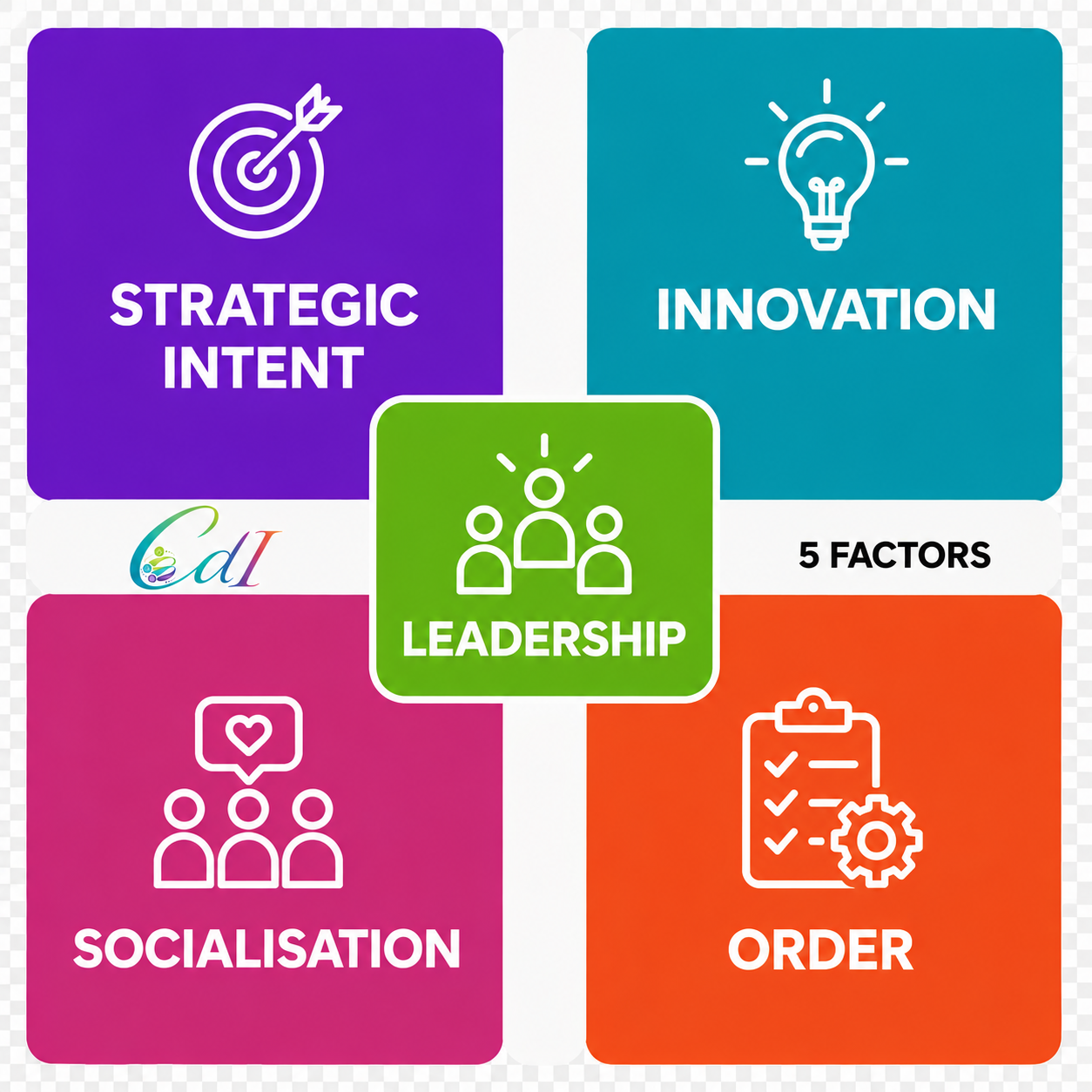
Five robust, independent pillars. the levers you pull before and after any change process.
Cronbach α reliabilites between 0.84 and 0.91
Cultural Styles
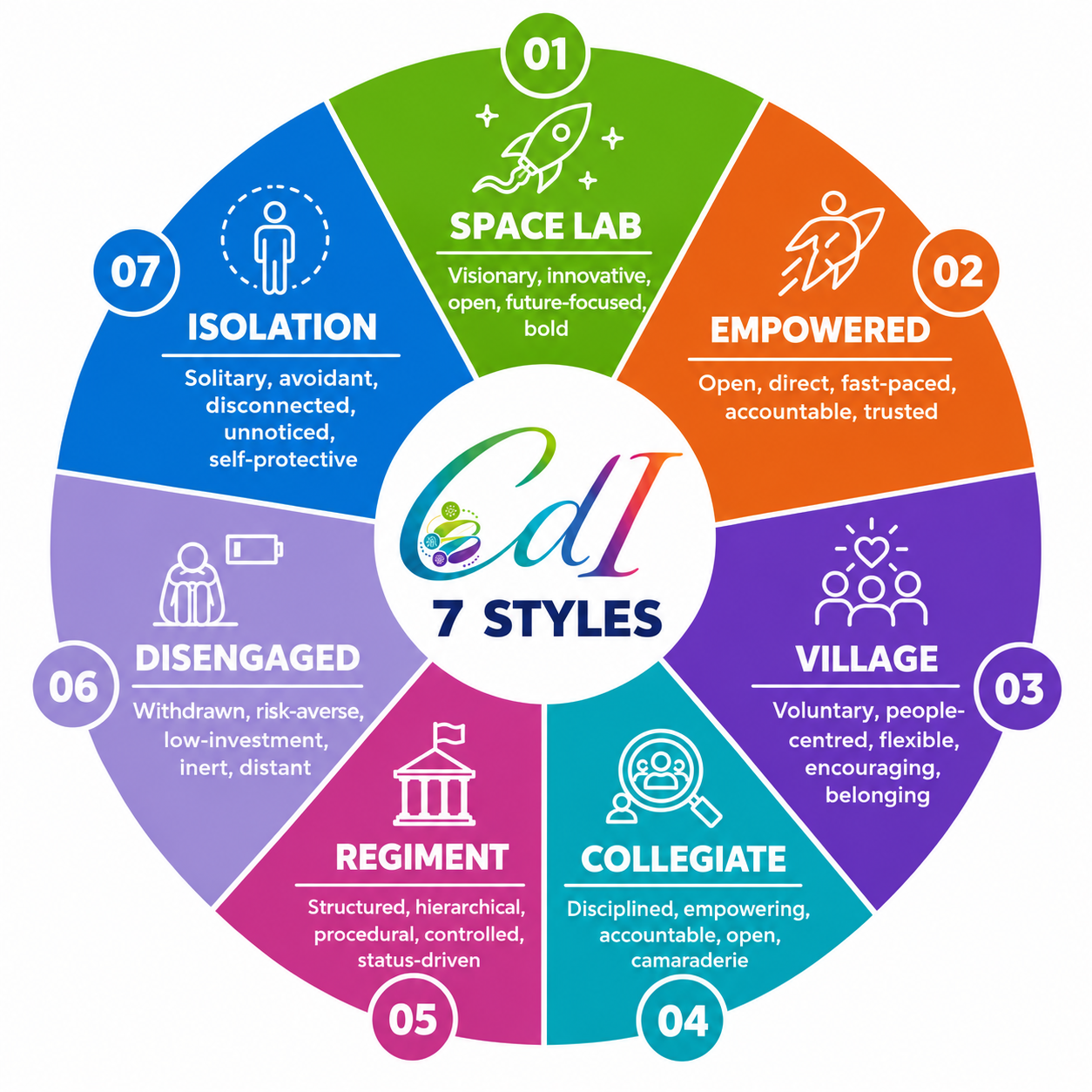
Seven styles that describe what your organisation feels like from the inside. A narrative leaders can recognise, and act on.
Cronbach α reliabilites between 0.78 and 0.91
What Is the CdI?
Every organisation has its own culture or “personality” — an invisible set of rules that shapes how decisions get made, how people behave under pressure, and why some strategies take hold while others die in the boardroom. The CdI makes that culture visible.
It measures culture as “the way we do, and experience things here” — not how people feel about it (that’s climate), but how the organisation actually operates. And unlike any other instrument in the world, it does this simultaneously at three levels.
Where the CdI Makes a Difference
- Understanding your culture as it actually is today.
- Can be applied to uncover the gap between current and ideal culture.
- Positioning and executing strategy in light of your actual culture.
- Setting a baseline before change, and measuring the real results after.
- Cultural due diligence in mergers and acquisitions.
- Comparing divisions, teams, or whole organisations.
Why the CdI
The only assessment of its kind in the world — 18 constructs measured simultaneously across three levels in a single online administration. Over 30 years in development, across four iterative versions since 1994, and statistically robust. Results are completely anonymous and reported at group level, so no individual response can ever be extracted. Every engagement produces three rich reports — Paradigm, Factors, and Styles — each with graphical output and narrative discussion, completed entirely online.
Real understanding of a topic only comes once you see how its parts work together. The reality is that trying to understand some complex issue can quickly become confusing. This is especially true if one attempts to understand the relationships between concepts from different disciplines.
Before considering culture and its possible links with ideas from other subjects the octopus might give a basic framework to assist in creating an overall and integrated understanding.
The animal that could best illustrate, or be “the face” of, culture is probably an octopus. Consider the complexity of multiple tentacles, three hearts, nine brains and a chameleon-like ability to change colour. Add to this the flexibility that allows it to mould itself into almost any shape. Attempting to understand an octopus from the perspective of its complex parts becomes an almost impossible task. Similarly, culture is a complex concept with multiple dimensions, drivers and ‘tentacles’ that affect and influence almost all aspects of business functioning. At times, the cultural tentacles are so well camouflaged and almost invisible, that it requires extensive scrutiny to identify. Just like with the octopus, trying to understand the detail of culture is almost impossible if you do not first understand its “octopus-ness”.